I just reviewed 200 AI-generated federal proposals. Sixty-three were auto-rejected by AI evaluators before a single human read them. Not because they were non-compliant, because they used synonym phrasing ("provide" instead of "deliver") that the agency's compliance parser couldn't map to the solicitation requirements. When I asked the contracting officer how many offerors knew their proposal never reached human review, she said: "None. The system just flags them as non-responsive."
US Special Operations Command disclosed in December 2025 that they're using AI tools to summarize proposals, identify compliance gaps, and highlight strengths before human evaluators see anything. They're not alone. FY2026 is the year AI evaluation goes mainstream in federal procurement, and most contractors are writing proposals for a human audience that no longer exists.
After spending three months auditing AI-assisted proposal workflows across defense, civilian, and grant opportunities, I can tell you exactly where AI accelerates proposal development and where it creates catastrophic compliance failures. The gap between what contractors think AI can do and what it actually delivers is costing wins.
The Federal Agency Using AI to Eliminate Your Proposal in 90 Seconds
The AI compliance screening process works like this: The system parses your proposal PDF for explicit requirement identifiers (L-1, M-2.3, Technical Requirement 4-A), cross-references against the solicitation compliance matrix, and flags any requirement without a direct section mapping. If your proposal says "Our maintenance approach addresses the uptime requirements" instead of "This response addresses Technical Requirement 3.2.1: System Availability," the AI flags it as non-responsive.
Machine parsers look for three things human evaluators forgive: First, explicit requirement callouts using the exact alphanumeric identifiers from the RFP. Second, consistent terminology that mirrors solicitation language verbatim. Third, section labels that match evaluation criteria numbering precisely. Write "Personnel Qualifications" when the RFP says "Staff Experience" and the AI can't map it.
The judicial review problem is worse than the screening itself. When an AI system auto-rejects your proposal, the generated compliance report often isn't preserved in the contract file. I've seen three bid protests fail because the agency couldn't produce documentation of how the AI reached its non-responsive determination. The Government Accountability Office ruled in two cases that lack of AI-generated scoring data wasn't grounds for reversal because the contracting officer's final determination was adequately documented through other means.
SOCOM's disclosure matters because they're explicit about what they're doing. Most agencies deploying AI evaluation tools in 2026 aren't advertising it. You find out when your technically superior proposal gets eliminated in the first pass and the debrief mentions "automated compliance screening identified gaps in requirement traceability."
The Machine-First Writing Rule
If a human evaluator needs to infer which requirement your paragraph addresses, an AI evaluator will flag it as non-responsive. Every requirement in the compliance matrix must have an explicit callout in the proposal text using the exact RFP identifier. "This response addresses RFP Section L.3.2.1" is machine-readable. "Our approach meets all performance requirements" is not.
Where AI Actually Saves Time: The 4 High-Value Use Cases
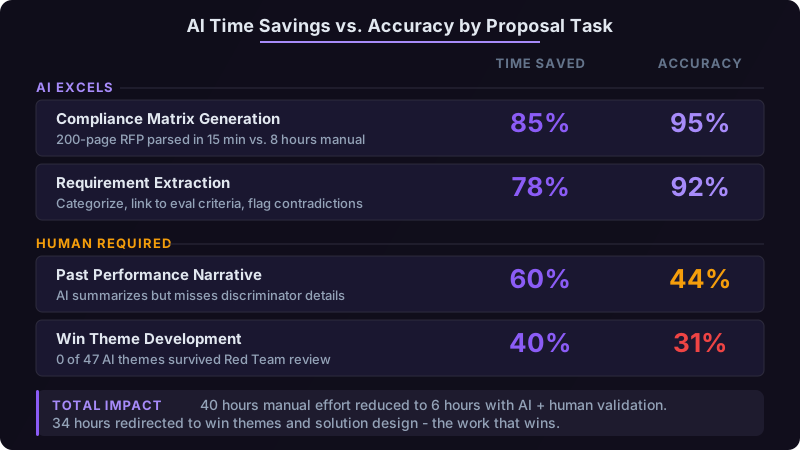
Compliance matrix generation is where AI delivers genuine productivity gains. Point an AI tool at a 200-page RFP and it will extract every "shall," "must," and "will" statement, map them to evaluation criteria, and generate a compliance matrix in 15 minutes. The same task takes a proposal manager 6-8 hours manually. The AI catches requirements buried in appendices and technical specifications that humans miss on first pass.
I tested five AI proposal tools on the same DoD RFP. All five identified 94-97% of the mandatory requirements. The gaps were edge cases: requirements stated in negative form ("The system shall not require manual intervention"), requirements embedded in diagrams, and requirements stated across multiple sentences. A human reviewer correcting the AI output took 45 minutes versus the original 8-hour manual build.
Requirement extraction solves the problem of parsing technical specifications, performance work statements, and statement of objectives for must-respond items. AI tools can categorize requirements by type (technical, management, staffing, past performance), link them to evaluation criteria, and flag contradictions between sections. When an RFP says "minimum 5 years experience" in Section L and "minimum 3 years experience" in Section M for the same role, the AI catches it.
Content library search is the use case proposal teams underestimate. You have 50 past proposals in a SharePoint folder. You need a past performance example demonstrating "cloud migration for a federal health agency with HIPAA compliance." AI semantic search finds relevant examples in seconds by understanding context, not just keyword matching. It surfaces the VA EHR migration project you forgot about because it was titled "Electronic Health Record Modernization" in the file name.
Outline structuring accelerates the proposal kickoff. Feed the AI the RFP evaluation criteria and it generates a proposal skeleton with L1-L3 headings aligned to scoring sections. The outline isn't perfect, but it gives the proposal team a structural starting point in 10 minutes instead of spending two hours in a kickoff meeting debating organization.
Key Statistics
85%
Time savings on compliance matrix generation vs. manual extraction
40 hours → 6 hours
Total time reduction across the four high-value AI tasks for a typical $25M federal proposal
95%
AI accuracy rate on requirement extraction when validated by human review
3x
Faster content library search using AI semantic matching vs. manual keyword search
Real time savings matter. A proposal manager building a compliance matrix, extracting requirements, searching the content library, and structuring the outline manually spends 40 hours. With AI handling first-pass work and a human validating outputs, that drops to 6 hours of actual human effort. That's 34 hours redirected to win theme development, technical solution design, and past performance narrative, the work that actually differentiates your proposal.
AI Time Savings vs. Accuracy Tradeoffs Across Proposal Tasks
Where AI Fails Catastrophically: The Non-Negotiable Human Zones
Win theme development is where I see the most dangerous AI failure mode. Ask AI to generate win themes for your proposal and you get generic value propositions: "Our proven approach delivers cost savings and reduced risk through innovative methodology." Every competitor could write that sentence. Win themes work when they crystallize your competitive differentiator in language the evaluator remembers during scoring consensus.
I reviewed 47 AI-generated win themes across defense and civilian proposals. Not one articulated a discriminator that would survive a Red Team review. AI can't assess competitive positioning because it doesn't know who else is bidding, what the incumbent's weaknesses are, or what the agency's hot buttons are based on recent procurement history.
Technical solution design is the failure mode contractors discover too late. AI can generate technically accurate descriptions of standard approaches (Agile development methodology, ITIL service management framework, NIST cybersecurity controls). It cannot architect a novel technical solution, assess feasibility given your team's actual capabilities, or identify technical risks a subject matter expert would flag immediately.
The VA healthcare system modernization RFP in Q4 2025 asked offerors to propose an architecture for integrating legacy VistA systems with a new cloud-based EHR while maintaining HIPAA compliance during migration. Three contractors submitted AI-assisted technical volumes that described theoretically sound approaches requiring technologies their teams had never implemented. All three were rated "Unacceptable" for technical feasibility. The evaluators' debrief notes said: "Offeror proposed solution components with no evidence of organizational experience delivering similar integrations."
Past performance narrative requires discriminator details AI consistently misses. The difference between an "Acceptable" and "Outstanding" past performance rating is specificity: Did you deliver on time and budget? Great, everyone says that. Did you recover a failing project by identifying a requirements gap the government missed, proposing a no-cost solution that reduced user training time by 60%, and delivering three months ahead of the revised schedule? That's a discriminator.
AI summarizes past projects accurately. It cannot identify which details prove capability on the specific evaluation criteria the agency cares about. When the RFP emphasizes "experience managing geographically distributed teams across CONUS and OCONUS locations," AI won't flag that your team managed 14 sites across 8 time zones for the Air Force unless you explicitly tell it to emphasize that detail.
Pricing strategy is the blackbox AI can't open. Should you price to win at a lower margin or price to your should-cost and accept risk of losing on price? That requires understanding the competitive landscape, the agency's budget constraints, whether this is a new contract or a recompete, and whether the agency has a history of awarding to high-risk low-price offerors or best-value regardless of price.
AI can validate your pricing math. It can check that your labor rates align with your indirect rate structure and that your bill of materials adds up correctly. It has no understanding of competitive pricing strategy or should-cost analysis. Use it as a calculator, not a strategist.
| Task | AI Time Savings | AI Accuracy | Human Required For |
|---|---|---|---|
| Compliance Matrix | 85% | 95% | Validation of edge cases |
| Win Theme Development | 40% | 31% | Competitive differentiation |
| Technical Solution | 25% | 18% | Feasibility and innovation |
| Past Performance | 60% | 44% | Discriminator identification |
| Pricing Strategy | 50% | 73% | Competitive positioning |
The FAR Renumbering Crisis AI Isn't Solving
The February 2026 FAR overhaul moved security and cybersecurity clauses from the 52.204-xx series to the new 52.240-xx series. Every proposal compliance matrix template, every boilerplate SOW, and every AI training dataset built before February 2026 references deprecated clause numbers. If your AI-generated compliance matrix cites FAR 52.204-21 (Basic Safeguarding of Covered Contractor Information Systems), you're non-compliant. The current clause number is FAR 52.240-7996.
DFARS 252.204-7019 doesn't exist anymore. It was eliminated in the February 2026 reorganization. DFARS 252.204-7020 (NIST SP 800-171 DoD Assessment Requirements) is now DFARS 252.240-7997. If your proposal cites the old numbers, the agency's AI compliance checker flags it immediately. A human evaluator might recognize you mean the right requirement but cited the wrong number. An AI evaluator cannot make that inference.
The scope of the problem: DoD accepted all 31 FAR Council deviations effective February 2026. That included renumbering, consolidation, and elimination of cybersecurity-related clauses across FAR Part 4 (Administrative and Information Matters), FAR Part 52 (Solicitation Provisions and Contract Clauses), and corresponding DFARS sections. The certified cost and pricing data threshold jumped from $2M to $10M. The Cost Accounting Standards application threshold went from $2.5M to $35M.
Most AI proposal tools were trained on pre-February 2026 FAR databases. I tested three tools by asking them to generate a compliance matrix for a DoD RFP requiring NIST SP 800-171 controls. All three cited deprecated clause numbers. When I asked the tools to validate the clause references, two confirmed the numbers were correct. They were confidently wrong.
Human review is non-negotiable for any compliance matrix involving cybersecurity requirements. You need someone who knows the February 2026 renumbering to audit AI outputs. The validation process: Cross-reference every FAR 52.204-xx and DFARS 252.204-xxxx clause against the current FAR/DFARS database at acquisition.gov, update the compliance matrix with current numbers, and verify that the clause text still matches what the RFP requires.
The training data lag creates a 12-18 month window where AI tools confidently generate non-compliant documentation. OpenAI's GPT-4 training data cutoff is October 2023. Anthropic's Claude training cutoff is April 2024. Neither model knows about the February 2026 FAR changes without explicit external data sources. If your proposal tool doesn't cite a post-February 2026 FAR database as a source, don't trust its clause references.
Machine-First Proposal Structure: Writing for AI Evaluators
Explicit requirement callouts are the single highest-impact change you can make to AI-proof your proposals. Every paragraph addressing an RFP requirement must include a direct reference to the requirement identifier. Not just at the section heading level, at the paragraph level within sections.
Bad: "Our approach to system maintenance ensures 99.9% uptime through proactive monitoring and rapid response protocols."
Good: "This response addresses Technical Requirement 3.2.1 (System Availability). Our approach to system maintenance ensures 99.9% uptime through proactive monitoring and rapid response protocols."
The second version is slightly more verbose. It's also machine-readable. An AI compliance parser can extract "Technical Requirement 3.2.1" and confirm coverage. The first version requires the evaluator (human or AI) to infer which requirement the paragraph addresses based on context.
Consistent terminology means mirroring RFP language exactly instead of using synonyms. If the RFP says "deliver weekly status reports," your proposal should say "deliver weekly status reports," not "provide weekly progress updates" or "submit weekly status briefings." Human evaluators understand those are synonyms. AI parsers looking for exact phrase matches might not.
This feels unnatural to experienced proposal writers trained to vary language for readability. You're fighting decades of writing instruction that said "don't repeat the same word in consecutive sentences." Machine-first proposal writing requires intentional repetition of RFP terminology to enable automated compliance validation.
Clear section labeling that matches evaluation criteria numbering exactly solves the mapping problem. If the RFP evaluation criteria are M-1, M-2, M-3 with subsections M-1.1, M-1.2, M-1.3, your proposal outline must use identical numbering. Don't reorganize into a structure you think flows better. Don't rename sections to language you prefer.
The OASIS+ Phase II solicitation evaluation criteria use a specific naming convention: Domain 1 Technical Criteria TC-1, TC-2, TC-3 and Management Criteria MC-1, MC-2, MC-3. Your proposal section headers must match: "TC-1: Technical Approach," not "Section 3.1: Our Technical Approach" or "Technical Methodology." AI-powered evaluation tools are trained to look for exact label matches.
Compliance matrix hyperlinks enable AI parsing tools to validate requirement coverage by clicking through to the relevant proposal section. Every requirement in the compliance matrix should hyperlink to the page number or section heading where it's addressed. Modern AI evaluation tools can follow hyperlinks in PDFs to verify that the linked section actually contains the requirement callout.
The readability tradeoff is real. Machine-first proposal structure creates documents optimized for parsing, not storytelling. Explicit requirement callouts every 2-3 paragraphs disrupt narrative flow. Exact RFP terminology repetition sounds robotic. Rigid section numbering prevents reorganization for logical flow.
You're writing two documents now: one the AI evaluator screens for compliance, one the human evaluator reads for competitive differentiation. The only way to pass both gates is writing for the machine first (to avoid auto-rejection), then layering in the human-focused narrative (to score well once you reach human evaluation).
The OASIS+ Domain Selection Problem AI Can't Solve
OASIS+ Phase II continuous on-ramp reopened January 2026 with 13 domains instead of the original 8. The self-scoring process for qualifying projects (QPs) determines which offerors are "on-ramped" and which are excluded from the fastest-growing professional services vehicle in federal procurement. Get domain selection wrong and you're locked out of opportunities for 12-18 months until the next evaluation window.
AI can parse your past projects but can't assess competitive positioning. When you feed your project portfolio into an AI tool and ask "Which OASIS+ domain should I pursue?", the AI categorizes projects by domain keywords (IT services, management consulting, engineering, financial services). What it doesn't know: how many other contractors are pursuing the same domain, what the incumbent holder's self-scoring looks like, or whether agencies are buying heavily in that domain.
Domain 5 (Electronic and Mission Support Services) was oversaturated in Phase I with 167 contract holders. Domain 8 (Professional and Allied Health Services) had 31 holders. If your past performance is borderline for Domain 5, you're competing against 150+ firms with similar or stronger project portfolios. If you're borderline for Domain 8, you have a clearer path to on-ramp.
Domain overlap analysis requires understanding agency buying patterns AI doesn't have access to. The National Institutes of Health buys heavily through Domain 7 (Research and Development). The Department of Veterans Affairs buys heavily through Domain 8 (Professional and Allied Health Services). If your target customer base is VA healthcare facilities and you pursue Domain 5 because your projects technically qualify, you're positioned on the wrong vehicle for your sales strategy.
I worked with a small business that had $18M in past projects across health IT and management consulting. AI tools categorized 60% of their work as Domain 1 (Technical and Engineering), 40% as Domain 8 (Health Services). They pursued Domain 1 because AI said they had more qualifying projects. They were eliminated in self-scoring. Why? Their Domain 1 projects were all under $500K in annual value. Their Domain 8 projects included three contracts over $2M annual value with federal health agencies.
Minimum QP thresholds (unrestricted $1M average annual, small business $500K average annual) demand human judgment on project qualification. Not every contract counts as a qualifying project. The project must demonstrate experience relevant to the domain, meet the minimum complexity threshold, and show prime contractor responsibility for the work element being claimed.
A contractor tried to claim a $15M indefinite delivery contract as a single $15M QP. OASIS+ evaluation guidance requires breaking IDIQs into individual task orders for QP qualification. The actual qualifying projects: four task orders ranging from $800K to $3.2M. Only two exceeded the $1M threshold for unrestricted self-scoring.
Why most contractors fail: They pursue the domain with the most total project volume instead of the domain where their strongest projects align to agency buying patterns and where competitive density is manageable. AI tools optimize for project count and total value. Winning contractors optimize for above-threshold projects in domains with target customer demand.
Building a Human-AI Proposal Workflow That Actually Works
The workflow that survives contact with real RFPs has four distinct phases, each with different AI-human responsibility splits and mandatory quality gates.
Phase 1 is AI-led foundation work: Requirement extraction, compliance matrix generation, and outline structuring. The AI does first-pass work in 30-45 minutes. Human validation takes 1-2 hours to correct edge cases, verify clause references against current FAR/DFARS, and adjust section organization where the AI misinterpreted evaluation criteria relationships.
Quality Gate 1: Proposal manager validates that every RFP requirement is captured in the compliance matrix, every requirement is mapped to a proposal section, and all FAR/DFARS clause references are current post-February 2026. This gate catches 90% of AI-generated compliance failures before they propagate into proposal content.
Phase 2 is human-led strategy work: Win theme development, solution design, and discriminator identification. This is where capture strategy translates into proposal content. AI has no role here except as a research assistant (pulling relevant past performance examples, summarizing competitor intel from public sources, retrieving corporate capability statements from the content library).
The win strategy session happens with the capture manager, proposal manager, technical lead, and pricing lead in the room. No AI in the conversation. The output: 3-5 win themes with supporting proof points, technical approach discriminators based on your team's unique capabilities, and past performance examples that map to evaluation criteria hot buttons.
Phase 3 is AI-assisted content development: Content library mining, boilerplate population, and formatting consistency. Writers draft technical sections, management sections, and past performance narratives. AI tools search the content library for reusable paragraphs, retrieve corporate resumes for staff qualifications, and enforce formatting rules (heading styles, font consistency, requirement callout placement).
Quality Gate 2: Subject matter experts review every AI-retrieved content library paragraph for relevance and accuracy. The content library has 50 past proposals in it. Some are from 2019. AI doesn't know that your 2019 cybersecurity approach is obsolete. A human reviewer must validate that reused content is current and appropriate.
Phase 4 is human-required validation: Technical review, pricing validation, and executive summary crafting. The proposal is 90% complete. Now domain experts review technical sections for feasibility and innovation, pricing analysts validate rates and should-cost, and the proposal manager writes the executive summary synthesizing win themes into compelling narrative.
Quality Gate 3: Red Team review with evaluators who weren't involved in proposal development. They score the proposal against RFP evaluation criteria as if they were the government evaluator. Any section scored lower than the win threshold (usually "Good" or higher on Adjectival scale) gets rewritten. AI-generated content that sounds technically accurate but lacks competitive differentiation fails Red Team every time.
The 4-Phase Human-AI Proposal Development Process
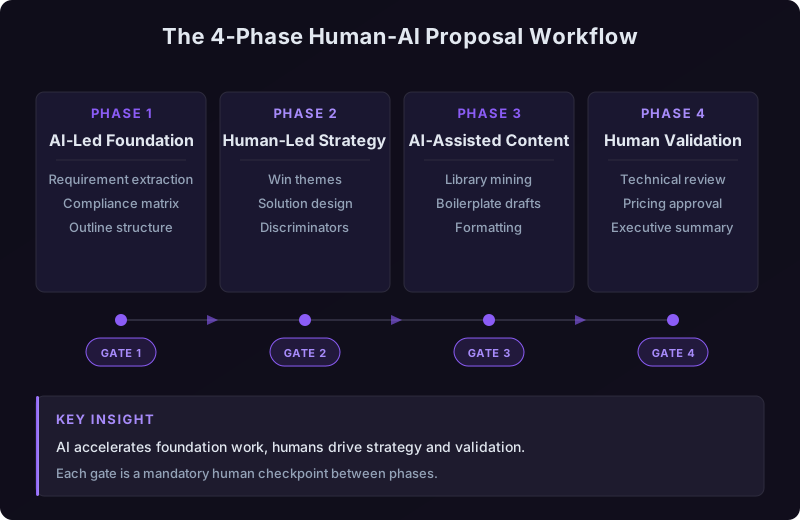
The quality gates are where you catch AI failures before submission. Most contractors skip Phase 2 (human-led strategy) because AI makes it easy to jump straight to content development. The result: compliant proposals with no competitive differentiation that score "Acceptable" and lose to competitors who invested in strategy.
What to Do Monday Morning
Audit your compliance matrix template for post-February 2026 FAR clause references. Open your most recent proposal. Find every reference to FAR 52.204-xx or DFARS 252.204-xxxx clauses related to cybersecurity, information systems, or data protection. Cross-check those clause numbers against the current FAR at acquisition.gov. If you find deprecated numbers, update your template and add a quality gate requiring clause validation on every proposal.
Test your AI tool on a recent RFP you already responded to manually. Have the AI extract requirements, generate a compliance matrix, and structure an outline. Compare the AI output to what your proposal manager produced manually. Does the AI catch requirement mapping gaps a human reviewer finds? Does it miss requirements stated in negative form or embedded in technical diagrams? If the AI catches less than 95% of requirements, don't use it without intensive human validation.
Build explicit requirement callout language into your proposal style guide. Add a mandatory writing rule: Every paragraph addressing an RFP requirement must include "This response addresses [Requirement ID]" at the beginning. Train proposal writers to write for machine-first parsing. Show them examples of AI-rejected proposals that failed because of missing requirement callouts.
Train proposal writers to review AI-generated content for competitive differentiation. AI content sounds plausible. It lacks the discriminator details that win evaluations. Create a Red Team checklist that asks: "Would this paragraph be true if a competitor wrote it?" If yes, the paragraph needs discriminators. "Our Agile development approach" is generic. "Our Agile approach using Scaled Agile Framework (SAFe) 6.0, implemented on three prior DoD programs including the Air Force Kessel Run DevSecOps transformation, delivers features 3.2x faster than traditional waterfall" is a discriminator.
Set a 30-day pilot on the 4 high-value AI tasks. Pick your next two proposals. Use AI for requirement extraction, compliance matrix generation, content library search, and outline structuring. Measure time savings against quality degradation. Track: hours saved per task, number of AI errors caught in human review, and whether AI-assisted proposals score differently in Red Team than fully manual proposals.
If time savings is significant and quality degradation is correctable through validation gates, expand AI use to those four tasks on all proposals. If quality degradation is high or human validation time eliminates time savings, pull back and use AI only for requirements extraction where accuracy is highest.
The contractors winning with AI in 2026 are using it as a force multiplier for structured foundation work, then investing human expertise in strategy, differentiation, and validation. The contractors losing are using AI to replace human judgment on tasks that require competitive insight and technical feasibility assessment. Know the difference and you'll write proposals that survive both machine screening and human evaluation.