I've watched a dozen qualified contractors burn 400+ hours on proposals only to get disqualified before technical evaluation. Not because of weak solutions. Not because of pricing. Because they didn't realize CMMC 2.0 Level 2 certification was a hard requirement that needed to exist six months before they clicked "submit."
November 2025 changed everything. CMMC Phase 2 rolled out, and by Q1 2026, major aerospace primes had disqualified 40% of their traditional teaming partners. The compliance window didn't just narrow, it closed. If you're still treating CMMC as something you'll "address during proposal development," you're already too late for your next DoD bid.
The real damage isn't the lost bids. It is the capture investment you make before discovering your teaming strategy is legally invalid. Prime contractors now require certification evidence in teaming agreements, not commitment letters promising future compliance. Third-party assessors take 60 to 90 days to verify your System Security Plan against 110 discrete NIST SP 800-171 Rev 2 controls. Your traditional 45-day proposal schedule doesn't account for that math.
The Compliance Window Has Closed (And Most Teams Don't Know It Yet)
CMMC 2.0 Level 2 is not a future requirement agencies are phasing in gradually. It is operational right now. DoD solicitations issued after November 2025 treat cybersecurity certification as table stakes, the same way active SAM registration or proper NAICS codes have always been non-negotiable. You either have it when the RFP drops, or you don't bid.
The Deloitte fabricated references crisis taught us what happens when contractors accelerate without governance frameworks. Fabricated citations in AI-generated government reports created accountability nightmares that rippled through the entire federal contracting community. CMMC 2.0 eliminated the room for similar mistakes in cybersecurity compliance. There is no "we'll fix it in final" option. Evaluators verify certification status before reading your technical approach.
Prime contractors adapted faster than the market expected. In early 2026, teaming discussions now start with a single question: "Send me your current C3PAO assessment report." Not a capability statement. Not past performance references. Your third-party assessor verification, dated within the last 12 months, with Level 2 certification explicitly confirmed.
I know a mid-tier systems integrator who spent eight weeks in capture, developed a teaming strategy with three specialized subs, and started drafting their technical volume. Two weeks before RFP release, they requested CMMC documentation from their teaming partners. One sub was in the assessment process (30 days from completion). Another had Level 1 but assumed "we'll upgrade during the contract." The third didn't know C3PAO assessment was required at all. The prime pulled out of the opportunity entirely.
Key Statistics
40%
Teaming partners disqualified by major aerospace primes in Q1 2026 due to missing CMMC certification
90 days
Average lead time for third-party C3PAO assessment and verification process
110+
Discrete NIST 800-171 Rev 2 controls requiring individual evidence and documentation
15-20 hours
Compliance documentation time per teaming partner vs. 2-3 hours pre-CMMC 2.0
91%
CMMC failures traced to documentation gaps, not technical security controls
The workforce crisis in federal acquisition makes this worse. With over 300 contracting officers lost in 2025, evaluation teams are shrinking while proposal volumes grow. Evaluators processing hundreds of pages in minutes can't afford to deep-read your cybersecurity explanations. They need to verify your certification number, confirm it's current, and move to technical scoring. If that verification fails or takes too long, you're out.
Your Compliance Matrix Template Is Now Legally Insufficient
Pull up your standard compliance matrix template. The one you've used successfully on the last six DoD bids. Look at the cybersecurity section. If it references NIST SP 800-171 Rev 1, or if it treats CMMC as a single line item with "compliant" in the response column, you're using a legally insufficient document.
CMMC 2.0 requires explicit mapping to NIST SP 800-171 Rev 2, which updated several controls and introduced new assessment objectives. Most legacy compliance templates predate this revision. They reference generic "cybersecurity controls" or map to the older framework. Third-party assessors reviewing your proposal during evaluation will flag this immediately. Not as a weakness to discuss. As a disqualifying deficiency.
Your System Security Plan (SSP) can no longer exist as a separate artifact that compliance matrices vaguely reference. Each of the 110+ NIST controls requires specific pairing: the control identifier (like AC.L2-3.1.1 for Access Control), the corresponding section of your SSP where implementation is documented, the assessment objective the control addresses, and the verification method the C3PAO used.
I've seen compliance matrices that list "CMMC Level 2: Certified" as a single row. This doesn't pass muster anymore. Evaluators need to see control-level granularity. They need to trace your compliance claim to specific SSP sections and assessment outcomes. The matrix is not a summary of your security posture. It is a scorecard evaluators use to verify certification quickly.
Common mistakes that now disqualify before technical evaluation:
- Generic compliance language: "We comply with all applicable DFARS cybersecurity requirements" without control-specific mapping
- Missing assessment dates: Certification claims without the C3PAO completion date and assessor organization name
- Outdated control references: Mapping to NIST 800-171 Rev 1 instead of Rev 2, or worse, to generic "FISMA controls"
- SSP reference gaps: Claiming implementation without citing the specific SSP section and page number where evidence exists
- Single-row CMMC entries: Treating 110 discrete controls as one compliance item instead of individual mapped requirements
The human-in-the-loop principle matters here. If you're using AI tools to generate compliance matrices, every single control mapping needs subject matter expert verification. AI systems trained on pre-CMMC 2.0 proposals will generate outdated language. They'll map to Rev 1 controls because that's what exists in their training data. They'll create plausible-sounding but legally invalid compliance claims.
The New Teaming Documentation Burden Nobody Prepared For
Teaming agreements used to be relationship documents. Scope definition, pricing splits, roles and responsibilities. Maybe a generic clause about "complying with all applicable regulations." That language is dead. CMMC 2.0 transformed teaming agreements into legally binding compliance instruments that require the same rigor as your technical proposal.
Primes now require CMMC certification evidence attached to teaming agreements, not just commitment letters promising future compliance. The evidence package includes your C3PAO assessment report, your current System Security Plan (with sensitive details redacted but control implementation descriptions intact), certification expiration date, and assessor contact information for verification.
Subcontractor flow-down clauses can't be generic anymore. "Subcontractor agrees to comply with all applicable federal cybersecurity requirements" won't survive legal review. You need specific NIST 800-171 Rev 2 control flow-down language, particularly for controls where implementation depends on subcontractor systems and processes.
Here's what changed in the last six months: A major defense prime revised their standard teaming agreement template to 14 pages (previously 6). Ten of those pages now address CMMC-specific requirements, including:
- Control-specific flow-down clauses for each of the 32 controls where subcontractor implementation affects prime compliance
- Certification tracking obligations requiring subs to notify prime 90 days before certification expiration
- Assessment coordination requirements detailing how primes will verify sub compliance during annual reassessment cycles
- Evidence production timelines specifying turnaround times when RFPs require sub CMMC documentation in proposals
- Remediation protocols outlining what happens if sub falls out of compliance during contract performance
CMMC 2.0 Impact on Proposal Workflows
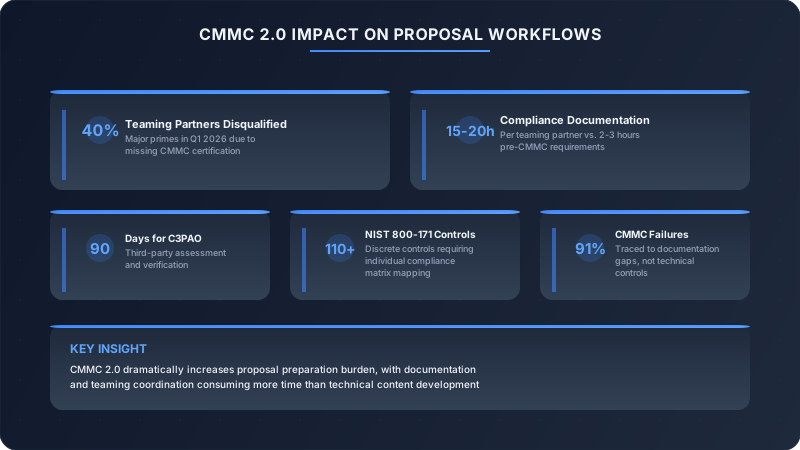
The time burden is real. Teams report 15 to 20 hours of compliance documentation per teaming partner now, compared to 2 to 3 hours before CMMC 2.0. That's not just filling out forms. It's coordinating with your cybersecurity team, extracting non-sensitive portions of your SSP, redacting proprietary details, getting legal review on control flow-down language, and assembling evidence packages that satisfy both prime requirements and government evaluation criteria.
Speed to compliant teaming agreement is becoming a competitive differentiator. If you can produce a legally complete teaming package in 48 hours while competitors need two weeks, you win partnerships. Prime contractors working compressed capture timelines can't afford slow teaming coordination. They'll choose the responsive partner over the technically superior one who creates schedule risk.
Partnership documentation frameworks matter now. Contractors maintaining template libraries with pre-approved flow-down language, standardized evidence packages, and legal-reviewed compliance clauses can respond to teaming opportunities 5x faster than those building from scratch each time.
What 'Continuous Compliance' Means for Reusable Content Libraries
The annual reassessment requirement in CMMC 2.0 broke the proposal content reuse model most contractors rely on. You can't maintain a static corporate capability statement that claims "CMMC Level 2 Certified" anymore. That certification expires. Your content library needs to know when.
Past performance narratives that reference cybersecurity posture now require date-stamped CMMC certification evidence. If you wrote a great case study 18 months ago about implementing secure development practices, and you're reusing that content in a current proposal, you need to verify your certification was active during the project period. Evaluators check this. They cross-reference your claimed compliance timelines with your assessment dates.
Corporate capability statements can't make blanket compliance claims. "ABC Corporation maintains CMMC Level 2 certification for all DoD work" is insufficient. You need to specify certification level, assessment completion date, assessor organization, and scope of certification (which facilities, which information systems, which organizational boundaries).
Content reuse systems need expiration date tracking. Every time your team pulls a cybersecurity capability description from the library, the system should flag whether the compliance claims are still valid. If your annual reassessment is due next month, content claiming "current CMMC certification" needs a warning flag before insertion into proposals.
The AI Content Risk Nobody Talks About
AI-assisted proposal generation tools trained on your historical win library will confidently insert outdated compliance claims. They don't track assessment dates. They don't know your certification expired. They just pattern-match and generate content that sounds authoritative. The Deloitte fabricated references crisis showed what happens when AI acceleration lacks verification frameworks. Every CMMC-related claim an AI system generates needs human verification against your current SSP and assessment report before it appears in a proposal.
I know a contractor who discovered this the hard way. Their AI proposal tool pulled a capability description from a 2024 win that claimed "fully compliant with NIST 800-171 Rev 2 across all business units." That was true when written. By 2026, one business unit had been sold, another facility's certification had lapsed, and the scope statement was factually inaccurate. The proposal went out with the incorrect claim. The evaluator caught it during verification. Instant disqualification, despite an otherwise strong technical solution.
The governance framework requirement is simple: AI generates draft content, subject matter expert validates compliance claims against current documentation, and no cybersecurity-related content appears in proposals without SME sign-off. Speed matters, but accuracy in regulated environments matters more.
How AI Proposal Tools Create New CMMC Liability Risks
AI proposal tools are now operational in government contracting workflows, not theoretical. Contractors use them to generate compliance matrices, draft technical approaches, and assemble proposal volumes. The productivity gains are real. So are the new liability risks, particularly around CMMC compliance claims.
AI systems hallucinate NIST control mappings. I've seen AI-generated compliance matrices that confidently map CMMC requirements to controls that don't exist in NIST SP 800-171 Rev 2. They invent plausible-sounding control identifiers like "AC.L2-3.1.15" (there are only 14 access control requirements at Level 2). They mix Rev 1 and Rev 2 control language. They fabricate assessment objectives.
These aren't edge cases. They happen regularly when AI systems generate compliance documentation without verification frameworks. The systems pattern-match on syntax that looks like NIST controls, generate content that reads authoritatively, and produce outputs that fail technical accuracy checks.
Automated content assembly creates a different risk. Your proposal automation platform pulls sections from your content library, stitches them together, and produces draft volumes. If that library contains outdated certification claims from previous wins, the automation will confidently insert them into current proposals. No human review, no verification that the claims are still valid, just assembly and output.
The human-in-the-loop requirement isn't optional anymore. Subject matter experts must verify every CMMC-related claim before submission. Not sampling. Not spot-checking. Every control mapping, every certification date, every SSP reference, every assessment outcome claim.
Best practice framework:
- AI generates draft compliance sections from RFP requirements and your content library
- Cybersecurity SME reviews all generated content against current SSP and C3PAO assessment report
- SME validates every control mapping to NIST SP 800-171 Rev 2, checking control identifiers, assessment objectives, and implementation descriptions
- SME verifies all certification claims against current documentation, including dates, scope, and assessor information
- Only validated content proceeds to proposal with SME digital sign-off confirming accuracy
This adds time. It creates a verification bottleneck. It slows down the AI acceleration benefit. But the alternative is fabricated compliance claims in federal proposals, which creates existential risk. The lesson from Deloitte's fabricated references is clear: speed without accuracy frameworks in regulated environments destroys credibility.
Evaluators know AI-generated content when they see it. The patterns are recognizable. They're specifically watching for hallucinated compliance claims now. If your compliance matrix contains control identifiers that don't exist, or assessment objectives that aren't in the NIST framework, or SSP references that don't align with your submitted documentation, they'll flag it instantly.
Restructuring Your Proposal Timeline for Pre-Bid Certification
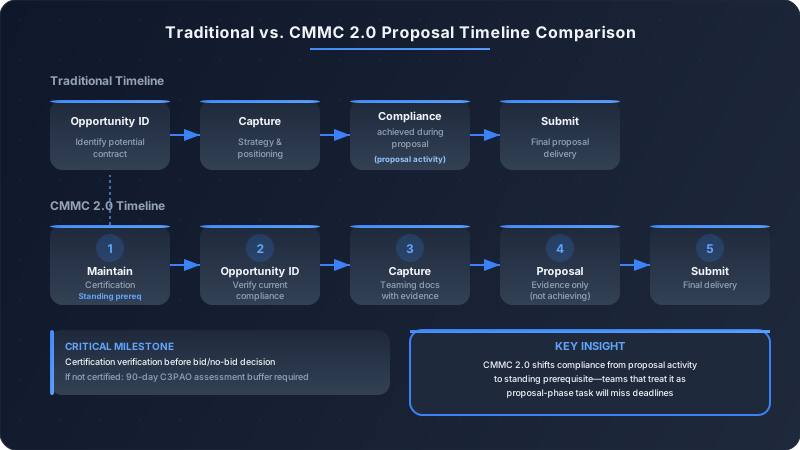
The traditional proposal model is dead. You can't start CMMC compliance when the RFP drops. You can't "address cybersecurity during proposal development." You can't plan to achieve certification before contract award. The new timeline math is unforgiving: certification must exist before you begin proposal response.
Traditional model (no longer viable): Opportunity identified → Capture planning → Proposal kickoff → Achieve CMMC compliance during technical writing → Submit proposal → Get certified during contract startup
CMMC 2.0 reality: Maintain standing certification → Opportunity identified → Verify current compliance status → Make bid/no-bid decision → Capture planning (compliance evidence only) → Proposal kickoff → Submit proposal with existing certification documentation
The critical shift is the bid/no-bid decision point. You can't make rational bid decisions without knowing your compliance status and your teaming partners' certification state. If you're not certified, add 90 days for C3PAO assessment. If your key sub isn't certified, add their timeline plus coordination overhead. If those timelines exceed the proposal schedule, the bid/no-bid answer is "no-bid" regardless of technical strength.
Traditional vs. CMMC 2.0 Proposal Timeline Comparison
Real-world failure scenario: A contractor identified a high-priority opportunity with a 60-day proposal window. Strong technical fit, existing customer relationship, favorable competitive landscape. They made a bid decision, assembled a team, and started technical writing. Three weeks in, they requested CMMC documentation from a critical subcontractor. The sub was in assessment but wouldn't complete certification for another 45 days. The prime couldn't submit the proposal without sub certification evidence. They had to withdraw, wasting three weeks of capture investment plus the relationship damage from pulling out mid-proposal.
The new capture phase includes a compliance verification milestone before serious proposal investment begins. You check your certification status, verify expiration dates, confirm scope alignment with the opportunity, and validate that all planned teaming partners have current certifications. Only after that verification do you commit resources to proposal development.
Portfolio-based approach beats opportunity-based scrambling. Maintain a certified teaming roster instead of assembling teams per opportunity. Establish standing relationships with certified partners across your capability areas. Verify their certification status quarterly. When opportunities arise, you're selecting from pre-verified partners instead of scrambling to find and certify new ones during compressed proposal timelines.
This requires organizational change. Your business development team needs compliance status visibility before opportunity pursuit decisions. Your capture managers need certification verification as a standard early-phase deliverable. Your proposal managers need to reject pursuit when compliance timelines don't support the schedule.
The contractors winning DoD bids in 2026 aren't necessarily the ones with the best technical solutions. They're the ones who restructured their pursuit processes to treat certification as infrastructure that exists before capture begins.
The Evaluator Burden Problem: Making CMMC Compliance Scannable
Federal agencies lost over 300 contracting officers in 2025. Evaluation teams shrunk. Proposal volumes didn't. Evaluators now process hundreds of pages in minutes, not hours. They're looking for reasons to eliminate proposals quickly so they can focus evaluation time on viable competitors.
Your CMMC compliance documentation either makes their job easy or it doesn't. If evaluators have to hunt through your proposal to verify certification status, read dense paragraphs to find your assessment date, or cross-reference multiple volumes to validate control mappings, you create cognitive load. Cognitive load in overwhelmed evaluators equals lower scores or outright elimination.
The compliance matrix is not a comprehensive explanation of your cybersecurity posture. It's a scorecard. Evaluators need to verify your certification exists, confirm it's current, validate it covers the scope of work, and move to technical evaluation. Design for that workflow.
Visual hierarchy matters more than comprehensive detail. Your certification number, assessment completion date, CMMC level, and C3PAO assessor name should be immediately visible. Not buried in paragraph three on page seven. In a table, at the top of your compliance section, with clear labels and unmissable formatting.
| Control Number | SSP Section | Implementation Status | Assessment Result | Evidence Location |
|---|---|---|---|---|
| AC.L2-3.1.1 | Section 4.2.1, pg 12 | Implemented | Pass | Appendix C, pg 142 |
| AC.L2-3.1.2 | Section 4.2.3, pg 15 | Implemented | Pass | Appendix C, pg 144 |
| AC.L2-3.1.3 | Section 4.3.1, pg 18 | Implemented | Pass | Appendix C, pg 146 |
| AC.L2-3.1.4 | Section 4.3.2, pg 20 | Implemented | Pass | Appendix C, pg 148 |
This format lets evaluators scan and verify in seconds per control. They see the control identifier, confirm it's valid, check your SSP reference, verify assessment pass status, and note evidence location. No hunting. No interpretation. Pure verification workflow.
One-page certification summary followed by detailed mapping appendix. Page one of your compliance section should contain: certification level, assessment date, assessor organization, certification expiration date, scope statement (which facilities and systems), and assessor contact information for verification. Evaluators who need more detail can read the appendix. Evaluators who just need to check the box can score you immediately and move on.
Evaluator-centric design is becoming a competitive edge. Two proposals with equally strong technical approaches, equal pricing, and similar past performance will score differently if one is scannable in five minutes and the other requires 20 minutes to verify compliance. The scannable proposal wins because it respects the evaluator's cognitive budget.
The 30-Minute Compliance Audit You Need to Run Today
Stop reading and open your current compliance matrix template. Not the one you plan to update. The one your team is using right now on active proposals. Run this audit:
Step 1: Control framework verification (5 minutes) Compare your cybersecurity section against the NIST SP 800-171 Rev 2 control list. Are you mapping to Rev 2 or Rev 1? Count the controls. NIST 800-171 Rev 2 has 110 controls across 14 families. If your template has a different number, you're using outdated or incomplete mapping. Download the current framework from NIST and identify the gaps.
Step 2: Teaming agreement template review (8 minutes) Pull your standard teaming agreement template. Search for CMMC-specific language. Do you have explicit NIST 800-171 control flow-down clauses? Do you require subcontractors to provide C3PAO assessment reports? Do you have certification expiration notification requirements? If your template predates November 2025, it's almost certainly insufficient.
Step 3: Content library compliance claims audit (10 minutes) Search your proposal content library for the words "CMMC," "NIST 800-171," and "cybersecurity certified." For each result, check the creation date and verify the compliance claim is still valid. Flag any content that claims current certification without date stamps. Flag any content that references capabilities you no longer have or certifications that have expired.
Step 4: AI tool verification checkpoint review (5 minutes) If you use AI tools for proposal generation, document where human verification occurs in your workflow. Who reviews AI-generated compliance content? What checklist do they use? How do they verify control mappings against your current SSP? If you don't have written procedures for AI content verification, you have uncontrolled compliance risk.
Step 5: Active proposal compliance check (2 minutes) List every proposal currently in development or about to submit. For each one, ask: Does this proposal claim CMMC compliance? If yes, is proper certification evidence attached? Are all teaming partners' certifications verified and current? If you can't answer these questions immediately, you have proposals in flight with potential disqualifying deficiencies.
This 30-minute audit identifies the gaps between your current state and CMMC 2.0 requirements. The findings won't be comfortable. Most contractors discover they have outdated templates, insufficient teaming language, compliance claims in their content library that are no longer valid, and active proposals that don't meet current requirements.
The metric you should start tracking this week: certification verification lead time. Measure how long it takes from "we want to bid this opportunity" to "we've verified our certification and all teaming partners' certifications are current and cover the scope." If that number is more than 48 hours, you have a process bottleneck that will cost you opportunities.
Portfolio-based compliance management beats reactive scrambling. Maintain a dashboard of your certification status, expiration dates, and certified teaming partners. Update it monthly. When opportunities arise, you're making bid decisions from current data instead of discovering certification gaps mid-proposal.
The contractors still treating CMMC as a proposal-phase compliance task are already losing. The ones who restructured their business development, capture, and content management processes around continuous certification infrastructure are winning more bids with less stress. The shift isn't optional anymore. Phase 2 is here. Your proposal process either adapted or it's generating expensive no-decision outcomes.