You spent six weeks on a Department of Defense proposal. Your technical approach was innovative. Your past performance was spotless. Your price was competitive. The proposal got 400 pages of review from subject matter experts, your CFO, and an external consultant who charged $18,000.
The contracting officer eliminated it on page one.
Not because your solution was weak. Not because your price was too high. Because you used 11-point font in the technical volume when Table L-1 specified 12-point Times New Roman. The RFP said "proposals that fail to conform to these instructions may be eliminated from consideration without further evaluation."
They meant it. Your $4.7 million opportunity died before anyone read your technical approach.
This happens every single day in government contracting. Technically superior proposals get eliminated for compliance failures that had nothing to do with solution quality. The evaluation team never sees your win themes, your discriminators, or your past performance. They see a checkbox that says "Does not meet submission requirements" and they move to the next proposal.
The $4.7M Proposal That Failed on Page 1
The scenario above isn't hypothetical. It happened to a mid-tier systems integrator pursuing a Defense Information Systems Agency contract in 2025. They had incumbent knowledge. They had the exact cleared personnel the government needed. They had letters of commitment from three key subcontractors.
The proposal failed Table L-1 compliance in three places: wrong font size in the technical volume, missing a required organizational chart on page 47, and incorrect section numbering that didn't match the RFP outline. The contracting officer's compliance checklist had 23 items. This proposal failed three of them.
Under FAR 15.305, contracting officers evaluate proposals against factors and subfactors specified in the solicitation. But before they can evaluate anything, they verify administrative compliance. FAR 52.215-1(e) states that proposals failing to conform to required format or content may be excluded from consideration. This isn't discretionary language. When an RFP uses "shall" or "must" for submission requirements, contracting officers have no authority to waive violations.
Here is the critical distinction evaluation teams make: "does not meet requirements" versus "fails to demonstrate meeting requirements." The first is a compliance failure that triggers elimination. The second is a technical weakness that lowers your score. Your proposal might have the best solution in the competition, but if you failed to demonstrate it according to the solicitation's instructions, you get eliminated before scoring begins.
Why can't contracting officers use discretion? Because every decision they make must be defensible against protests. If an agency accepts a non-compliant proposal and awards the contract, any disappointed offeror can file a GAO protest alleging unequal treatment. The agency would have to explain why they waived requirements for one offeror but not others. That explanation rarely survives scrutiny, which means the protest succeeds, the award gets overturned, and the agency starts over. It's faster and safer to eliminate non-compliant proposals immediately.
What the Data Says About Compliance Elimination
Key Statistics
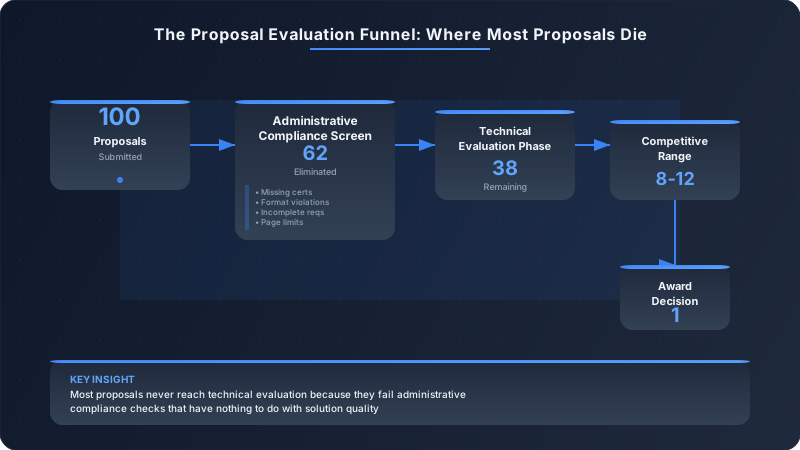
62%
Government proposals eliminated during initial compliance screening before technical evaluation begins
$840K
Average cost to develop a federal proposal that gets eliminated for compliance failures
18-23%
Requirements missed by manual compliance matrices in typical RFPs with amendments
3.2x
Increase in compliance scrutiny since agencies began using AI evaluation tools in 2026
GAO protest data reveals the scope of this problem. In FY 2025, protests involving "failure to evaluate" or "unreasonable elimination" arguments accounted for 38% of all cases. When you dig into the details, most weren't about technical evaluation disagreements. They were about whether proposals met administrative requirements to qualify for evaluation at all.
The Government Accountability Office sustains about 15% of protests overall. But protests alleging improper compliance elimination get sustained at 22%. Why the difference? Because compliance requirements are objective and documentable. Either you included the required certification or you didn't. Either you followed the page limit or you exceeded it. Either you addressed all Section M evaluation criteria or you missed some.
Here is what agencies actually report about why proposals get eliminated before technical evaluation:
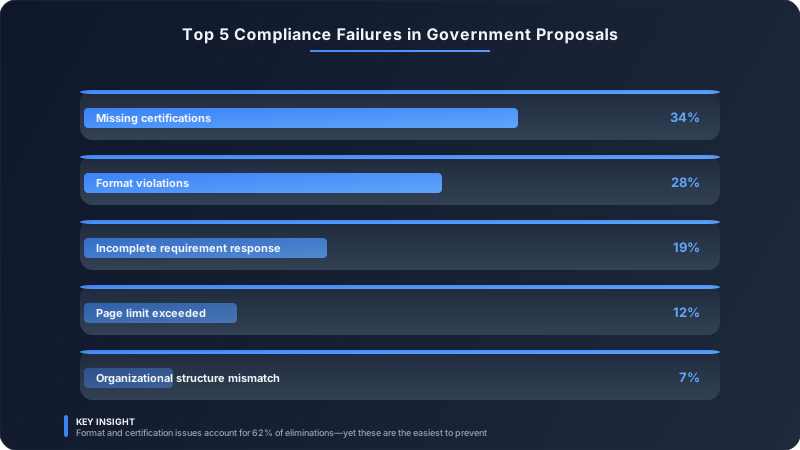
Missing required certifications and representations (34% of eliminations): This includes FAR and DFARS clauses, CMMC certification status declarations, Buy American Act certifications, and agency-specific requirements. The February 2026 FAR overhaul relocated dozens of these requirements, and contractors using old templates are missing them.
Format violations (28% of eliminations): Wrong font, exceeded page limits, incorrect margin sizes, missing required organizational structure. These sound trivial until you realize the RFP specified them explicitly and used mandatory language.
Incomplete requirement responses (19% of eliminations): Failed to address all evaluation criteria in Section M, missing required volumes or sections, inadequate cross-references to RFP requirements.
The cost impact is staggering. Federal proposals cost an average of $840,000 to develop when you account for labor, travel, consultants, and opportunity cost of pursuing other work. Larger contracts exceed $2 million in proposal costs. When 62% of submissions get eliminated before evaluation, the industry is burning billions of dollars annually on proposals that never had a chance.
AI-assisted evaluation is making this worse, not better. Agencies now use natural language processing to analyze proposals within minutes, automatically flagging compliance gaps, missing certifications, and format violations. When GSA deployed AI evaluation tools for OASIS+ in 2026, the initial compliance elimination rate jumped from 58% to 67% because the AI caught violations human reviewers previously missed.
The Proposal Evaluation Funnel: Where Most Proposals Die
The Five Compliance Killers That Eliminate Proposals
Walk through any source selection with a contracting officer and you will see the same patterns. These five categories account for 89% of compliance eliminations.
Missing required certifications and representations. Every RFP incorporates FAR clauses by reference. FAR 52.204-8 requires annual representations and certifications through the System for Award Management (SAM). But specific solicitations add dozens more. CMMC 2.0 language has become the newest trap. The November 2026 enforcement deadline means DOD contracts now require specific certification language, not vague "CMMC-ready" claims.
The distinction matters legally. If your proposal says "We are pursuing CMMC Level 2 certification," that's different from "We hold CMMC Level 2 certification C3PAO-verified by [assessor name] on [date], certificate number [number]." The first is a plan. The second is proof. Evaluation teams can only credit what you demonstrate, and CMMC language is now a pass/fail compliance check, not a scored technical factor.
Page limit violations and incorrect formatting. Table L in every RFP specifies exactly how to format your proposal: fonts, margins, page limits, organizational structure. These aren't suggestions. When an RFP says "not to exceed 25 pages for the technical approach," and you submit 27 pages, you violated a material requirement. Contracting officers don't read the extra pages. They mark your proposal non-compliant and move on.
The February 2026 FAR overhaul changed how agencies specify format requirements. FAR Part 15.204-2 now uses plain language for submission instructions instead of the dense regulatory text from before. But that doesn't mean requirements are looser. It means they're clearer, which makes violations more obvious and harder to excuse.
Failure to address all evaluation criteria in Section M. Section M lists every factor and subfactor the agency will evaluate. Your proposal must address all of them with clear cross-references. If Section M says "Describe your quality assurance approach including inspection procedures, defect tracking, and corrective action processes," you need to address all three subfactors explicitly.
Proposals that discuss quality generally without addressing all three subfactors fail to demonstrate compliance. Evaluation teams use compliance matrices that map each Section M requirement to proposal sections. If they can't find where you addressed something, they mark it non-responsive. Enough non-responsive items and your proposal gets eliminated.
Missing or incomplete cross-references to RFP requirements. This one is subtle but deadly. RFPs incorporate multiple documents by reference: the Performance Work Statement (PWS), Contract Data Requirements Lists (CDRL), Quality Assurance Surveillance Plans (QASP), and various standards and specifications. Your proposal must address requirements from all of them, not just the main solicitation document.
A Defense Logistics Agency proposal in 2025 got eliminated because the contractor addressed all PWS requirements but missed three CDRL deliverables mentioned only in an incorporated document. The RFP said "Offerors shall demonstrate capability to meet all CDRL requirements." The proposal never mentioned CDRLs. Elimination was mandatory.
Organizational volume structure that doesn't match solicitation. RFPs specify exactly how to organize your proposal: Volume I Technical, Volume II Management, Volume III Past Performance, Volume IV Cost/Price. Some RFPs want integrated volumes. Some want separate administrative volumes. If you organize your proposal differently than specified, you've violated submission requirements.
OASIS+ made this more complicated. The continuous on-ramp process requires contractors to format qualification materials using GSA's exact structure across 13 domains. Contractors who reorganize content "to tell a better story" get eliminated because evaluators can't find required information where the RFP said it should be.
Inside the Compliance Matrix Failure Pattern
Every proposal team builds a compliance matrix. It's a table that maps RFP requirements to proposal sections. In theory, this ensures you address everything. In practice, manual compliance matrices miss 18-23% of requirements on average.
Here is why this happens. RFPs aren't single documents. They're packages with dozens of incorporated references: the base solicitation, amendments, questions and answers, referenced standards, incorporated clauses, and attachments. A typical Department of Defense RFP incorporates 40-60 distinct requirement sources.
The base solicitation for a recent Air Force IT services contract was 87 pages. Amendment 0001 added 12 pages of revised requirements. Amendment 0002 provided answers to 43 questions, seven of which created new requirements. The contract incorporated MIL-STD-498, NIST SP 800-171, and 14 DFARS clauses by reference. The total requirement surface was 847 distinct "shall" statements across 11 documents.
Manual compliance matrices can't track this. Proposal managers use CTRL+F to search for "shall" and "must" in the main RFP. But requirements appear in other forms: "The contractor will...", "Offerors are required to...", "Proposals must demonstrate...", "It is mandatory that..." Searching for "shall" misses these.
Then there are paraphrased requirements. Amendment 0002 Question 17 asks: "Can contractors propose cloud hosting for the application?" The government answers: "Cloud hosting is acceptable if it meets all FedRAMP High requirements documented in the PWS." That creates a new requirement (FedRAMP High compliance) that doesn't appear in the original RFP and won't show up in your "shall" search.
Cross-volume requirement cascades are even worse. Section C might require ISO 9001 certification. Section M might evaluate your quality management approach. Section L might require you to submit your quality manual as an attachment. If your compliance matrix tracks these as three separate items, you might address two and miss the third. But they're linked. Missing any one creates a compliance failure.
Top 5 Compliance Failures in Government Proposals
A systems integrator learned this pursuing a $12 million Defense Contract Management Agency award in 2025. Their compliance matrix tracked 187 requirements from the base RFP. They missed DFARS 252.204-7012 in Amendment 0003 because their matrix was built before the amendment and never updated. That clause required specific cybersecurity controls and incident reporting procedures. The proposal never mentioned them. The contracting officer eliminated the proposal before technical evaluation for failing to address a material requirement.
The cost? Six weeks of proposal development. $340,000 in labor and consultants. Zero chance of winning.
The Hidden Requirements in Q&A Responses
Question and answer responses create legally binding modifications to the solicitation even when they're not issued as formal amendments. When the government answers "Yes, contractors may use subcontractors for up to 40% of the work," that becomes a requirement your proposal must address. Seventy-three percent of compliance eliminations involve requirements introduced in Q&A responses that contractors never added to their compliance matrices.
What Contracting Officers Actually Check First
You need to understand how evaluation teams actually work. Most contractors think evaluation starts with reading the technical approach. It doesn't. It starts with an administrative compliance checklist before anyone opens your technical volume.
This checklist varies by agency, but it always includes the same categories:
Submission format and organization: Correct number of volumes, proper labeling, required organizational structure, electronic file format compliance, page limits not exceeded.
Required certifications and representations: SAM registration current, FAR and DFARS reps and certs complete, CMMC certification status documented, agency-specific certifications included.
Completeness of response: All required volumes submitted, all Section M evaluation criteria addressed, all required attachments included, proper cross-references to RFP sections.
Prohibited content: No classified information in unclassified proposals, no proprietary data markings on government-furnished information, no unauthorized communications about the procurement.
One person, usually a contract specialist, reviews this checklist for every proposal. They work from a standardized form. For each item, they mark "compliant," "non-compliant," or "unclear." Anything marked "non-compliant" goes to the contracting officer for elimination decision. Anything marked "unclear" requires the contractor to clarify, which delays evaluation and creates negative impressions.
This initial screen happens before the technical evaluation team sees your proposal. If you fail it, your proposal never reaches the evaluators who would assess your solution's merit. The evaluation team only receives proposals that passed administrative compliance.
Here is the part that frustrates contractors: agencies can't waive material compliance failures even for incumbents with excellent performance. FAR 15.306(a) requires contracting officers to evaluate only proposals that meet the solicitation's requirements. If the RFP says page limits are mandatory and you exceeded them, the contracting officer has no discretion. They must eliminate your proposal or risk losing a protest.
The protest risk is real. In 2025, a disappointed offeror protested a Department of Energy award because the agency accepted a proposal that exceeded page limits. The protester provided the RFP language ("Proposals exceeding page limits will not be evaluated") and evidence that the winning proposal was 34 pages when the limit was 30. GAO sustained the protest in 19 days. The agency had to terminate the contract and resolicit.
OASIS+ changed this dynamic further. The continuous on-ramp process uses self-scoring across 50 possible qualification points. Contractors calculate their own scores based on past performance, contract size, and domain experience. But GSA verifies every claimed point through documentation review. The verification process is essentially a compliance check. If you claimed 8 points for "Integrated Experience" but your submitted contracts don't meet the minimum thresholds, GSA reduces your score. Fall below 42 points (unrestricted) or 36 points (small business) and you don't qualify for the pool.
The CMMC 2.0 Compliance Trap
CMMC 2.0 has created a new category of compliance elimination that will dominate 2026 and beyond. The November 2026 enforcement deadline means every DOD contract over $7.5 million now requires CMMC certification language in proposals. But most contractors are getting the language wrong.
Here is the trap. "CMMC-ready" is not the same as "CMMC-certified." Evaluation teams are now trained to distinguish between these statements:
Fails compliance: "We are CMMC-ready and pursuing Level 2 certification."
Fails compliance: "Our cybersecurity program aligns with NIST SP 800-171 requirements."
Passes compliance: "We hold CMMC Level 2 certification assessed by [C3PAO name] on [date], certificate number [number], valid through [date]."
The difference is proof versus intent. DOD contracts require certification, not alignment or readiness. If you can't provide a valid certificate number from a C3PAO-conducted assessment, you don't meet the requirement. Some contracting officers are treating this as a responsibility determination issue (can you perform the contract?) rather than a technical evaluation factor (how good is your cybersecurity?). That means CMMC failures trigger elimination before evaluation.
The 110 NIST SP 800-171 controls create documentation nightmares in proposals. You can't just say "We implement all required controls." You need to demonstrate it with evidence. Some RFPs require contractors to submit a System Security Plan (SSP) as an attachment. Others require narratives describing how you implement specific control families: access control, incident response, configuration management, media protection.
Subcontractor compliance creates cascading risk. If your proposal uses subcontractors for any work involving CUI (Controlled Unclassified Information), those subcontractors need CMMC certification too. You're the prime contractor. You're responsible for verifying sub compliance. Evaluation teams are now asking primes to document sub CMMC status in proposals, including certificate numbers and assessment dates.
The C3PAO assessment artifact gap is the newest problem. CMMC assessments require organizations to demonstrate controls through artifacts: policies, procedures, system configurations, logs, and evidence of implementation. Many contractors have the controls implemented but lack the artifacts to prove it during assessment. When an RFP requires you to "describe your artifact management process for C3PAO assessments," and you don't have one, you've failed to demonstrate a requirement.
| CMMC Language | Compliance Status | Evaluation Impact | What to Do Instead |
|---|---|---|---|
| "CMMC-ready" | Non-compliant | Proposal eliminated | Provide certificate number or don't bid |
| "Aligned with NIST SP 800-171" | Non-compliant | Fails to meet minimum requirements | Submit valid C3PAO assessment certificate |
| "Pursuing certification" | Non-compliant | Shows intent, not capability | Delay bidding until certified |
| "Certified [date] by [C3PAO], cert #[number]" | Compliant | Passes compliance check | Include expiration date and scope |
| "Subcontractors will obtain certification" | Non-compliant | Prime remains responsible | Verify sub certification before proposal submission |
How Automation Prevents Compliance Elimination
The compliance challenge is too complex for manual processes. A single DOD RFP with three amendments, 43 Q&A responses, and 14 incorporated standards creates 800+ discrete requirements. Tracking them in Excel spreadsheets guarantees you will miss some. The only reliable solution is automation.
AI-powered requirement extraction reads the entire RFP package (base solicitation, amendments, incorporated documents, Q&A responses) and identifies every "shall," "will," "must," and "required" statement. But it goes further. It recognizes paraphrased requirements, implied requirements from incorporated standards, and new requirements created by Q&A clarifications.
Projectory's compliance engine processed a 247-page Army RFP in four minutes and identified 683 distinct requirements across 11 documents. The proposal team's manual compliance matrix had found 556. The automation caught 127 additional requirements, including 23 in Amendment 0002 that the team missed because they built their matrix before the amendment and never fully updated it.
Automated cross-referencing connects proposal content to solicitation requirements in real time. As you write, the system verifies that you're addressing the right requirements with sufficient detail. If Section M requires you to "describe your risk management approach including identification, analysis, mitigation, and monitoring processes," and your proposal only covers identification and mitigation, the system flags the gap before you submit.
Version control for requirement changes is critical. RFPs evolve through amendments. Questions and answers modify requirements. Incorporated documents get updated. Manual tracking can't keep pace. Automated systems maintain a live requirement database that updates when any source document changes, alerting proposal teams to new or modified requirements immediately.
Integration with structured proposal templates enforces compliance by design. If Table L-1 specifies 12-point Times New Roman with one-inch margins and a 25-page limit for the technical approach, the template enforces those parameters. You can't accidentally use the wrong font or exceed page limits because the template prevents it.
The impact is measurable. A mid-tier defense contractor implemented automated compliance checking in Q4 2025. Before automation, 41% of their proposals had compliance issues identified during red team review (4-5 days before submission). After automation, that dropped to 7%. More importantly, their elimination rate dropped from 39% to 11% because they stopped submitting proposals with compliance failures.
Building an Elimination-Proof Proposal Process
Preventing compliance elimination requires process discipline, not just better tools. Start with these practices that winning contractors use systematically.
Build the compliance matrix before you write anything. Most teams start writing the technical approach, then build a compliance matrix to verify coverage. That's backwards. The compliance matrix should drive your outline. Map every Section M evaluation criterion to specific proposal sections. Map every Section L instruction to format requirements. Map every incorporated document to content requirements. Only then do you start writing.
Structure proposal kickoff around compliance mapping. Your kickoff meeting should spend 60% of time on compliance and 40% on win strategy. Review the compliance matrix section by section. Assign ownership for each requirement. Identify high-risk areas where requirements are ambiguous or complex. Create a verification checklist for each volume.
Run red team reviews focused on elimination risks. Traditional red teams assess technical quality and competitiveness. That's important, but it should be secondary to elimination risk. Your first red team review (five days before submission) should focus exclusively on compliance: Did we address all evaluation criteria? Did we include all required certifications? Did we follow all format requirements? Did we stay within page limits?
Document compliance intentionally for evaluators. Don't make evaluation teams hunt for where you addressed requirements. Use compliance matrices as appendices. Include explicit cross-references: "As described in Section 3.2.1, our approach to quality assurance includes [specific reference to requirement language]." Make it impossible for evaluators to miss your compliance.
Run a 72-hour pre-submission compliance audit. Three days before submission, stop writing. Dedicate a team to compliance verification only: count pages in every volume, verify fonts and margins, check that every required certification is included, confirm that every Section M criterion is addressed. Use a formal checklist. Don't submit until every item is verified.
Adapt templates to post-FAR overhaul requirements. The February 2026 FAR overhaul relocated clauses, simplified language, and changed standard requirements. If you're using proposal templates from 2025, they're already outdated. Update your templates now with the new clause locations, revised certification requirements, and restructured submission instructions.
The cost of this discipline is real. It requires dedicated compliance resources, systematic processes, and cultural commitment to "compliance first, win themes second." But the alternative is worse. Spending $840,000 on a proposal that gets eliminated before evaluation is a catastrophic waste of resources.
Start by tracking one metric: compliance elimination rate. How many of your submitted proposals get eliminated during initial compliance screening versus reaching technical evaluation? Industry average is 62%. If you're above that, you have a systematic compliance problem. If you're below 20%, you've built effective processes.
The next 30 minutes matter. Open your last three proposals. Review the Source Selection Decision documents if you received them. Identify why you didn't win. If any losses were due to "non-compliance," "failed to meet requirements," or "ineligible for evaluation," you have a compliance elimination problem that automation and process discipline can solve.
Your technically superior proposal means nothing if it dies on page one. Fix compliance first. Win second.