You open the solicitation at 9am. Your first instinct is to forward it to your proposal manager and ask for an outline by end of week. This instinct will cost you the contract.
The teams that win federal RFPs make their bid/no-bid decision within 72 hours, not 72 days. They build compliance matrices before they write a single word. They know that the February 2026 FAR overhaul invalidated every proposal template built before it, turning boilerplate libraries into liability factories. And they understand that 37% of proposals get eliminated in administrative review before an evaluator reads a single page of technical content.
This is the federal RFP response playbook nobody teaches. Not the idealized timeline where everyone collaborates seamlessly, but the 38-day gauntlet where four specific checkpoints determine whether you make it to technical evaluation or get administratively eliminated at Day 3, 10, 27, or 37.
The 72-Hour Window Nobody Talks About
The first three days after solicitation release determine your win probability more than the next 30. This isn't about competitive intelligence or teaming strategy. It's about compliance verification that most teams defer until Day 28, when it's too late to fix.
Day 1 is the FAR clause audit. The February 2026 overhaul changed 14 commonly-cited clause numbers and removed most non-statutory rules through a plain language rewrite. Your template library references FAR 52.232-20 for payment terms. The current solicitation cites FAR 52.232-40 because the numbering system changed. If you copy-paste your boilerplate without verification, you've just committed to payment terms that don't exist.
Day 2 is the Section L/M cross-reference build. Section L tells you what to submit. Section M tells you how it will be evaluated. The matrix maps every L requirement to its corresponding M evaluation criterion, creating a compliance scaffold before you assign a single writer. Teams that skip this step produce proposals where technical approach addresses criteria in narrative order instead of evaluation order, making it harder for evaluators to score and easier to miss requirements entirely.
Day 3 is the bid/no-bid decision with compliance intelligence. You're not deciding based on competitive positioning alone. You're deciding whether you can meet administrative requirements that will eliminate you before technical merit matters. The CMMC Level 2 certification requirement buried in Section C. The Modular Open Systems Architecture (MOSA) language now standard in DoD technical evaluations. The June 30, 2026 TINA threshold change affecting certified cost data requirements for contracts above $10M.
38-Day Federal RFP Response Timeline with Critical Decision Points

Days 1-3: The Compliance Audit That Prevents Elimination
Administrative review eliminates more proposals than technical evaluation. The data is consistent across agencies: 23-40% of submissions fail before an evaluator opens the technical volume. These aren't marginal losses. These are binary eliminations for missing signatures, incorrect clause references, or format violations that automated screening tools catch in seconds.
Start with the 22-item administrative checklist. SAM.gov registration active and expiration date beyond contract award date. Signatures on SF 1449 or SF 33 (depending on solicitation type). Reps and Certs current in SAM and matching solicitation requirements. Required certifications attached (Buy American, Trade Agreements Act, combating trafficking). Page limits verified for each volume. Format compliance (font size, margins, line spacing specified in Section L).
Then audit the FAR clause references. The February 2026 overhaul changed clause numbers for payment terms (52.232-20 became 52.232-40), contracting officer authority (52.242-1 became 52.242-15), and dispute resolution (52.233-1 was consolidated into 52.233-5). Cross-reference every clause cited in your proposal against the current FAR database. Your template library is not current. Trust nothing built before March 2026.
The CMMC Timing Trap
Primes are demanding CMMC Level 2 certification from subs before Phase 2 mandates it because the October 31, 2026 deadline creates supply chain risk. If you're waiting for the mandate to start your certification journey, you're already six months behind the competitive curve. C3PAO assessments are booking 4-6 months out.
The compliance matrix structure determines everything downstream. Build it as a spreadsheet with five columns: Section L Requirement (exact paragraph number and text), Section M Evaluation Criterion (the factor/subfactor it maps to), Compliance Evidence Required (what proof you must provide), Proposal Section (where you'll address it), and Status (compliant/risk/non-compliant).
Every L requirement must map to an M criterion. Every M criterion must connect to L evidence. When they don't align, you've found a gap. Either the solicitation has an error (rare but possible, grounds for a question), or you're misunderstanding the requirement (common, requires clarification before you write).
This matrix becomes your proposal outline. Not a narrative outline based on what story you want to tell, but a compliance outline based on what the evaluator needs to score. Technical approach doesn't start with your innovative solution. It starts with the first technical evaluation subfactor in Section M and addresses them in exact order.
Days 4-10: Capture Strategy Before Content Creation
Teams that start with outlines instead of capture plans spend 15+ revision cycles fixing fundamental strategic gaps that should have been resolved before anyone wrote a word. An outline organizes content. A capture plan defines what content proves you should win.
The capture plan starts with discriminators. What can you do that competitors cannot? Not aspirations. Capabilities you can prove with past performance references, teaming partner qualifications, or technical approaches you've already deployed. If your discriminator is "we're more agile," you don't have a discriminator. If your discriminator is "we reduced system latency from 240ms to 18ms on the Air Force's similar XYZ program using distributed caching architecture we can replicate here," you have something evaluators can score.
Win themes connect discriminators to evaluation criteria. The solicitation values "proven experience with similar systems." Your win theme: "We delivered the only operational implementation of [specific technology] currently deployed in a DoD environment, reducing [specific metric] by [percentage] while maintaining [compliance standard]." This theme must appear in your executive summary, technical approach, past performance narrative, and management plan. Repetition isn't redundant when it's mapped to evaluation consistency.
DoD solicitations now expect MOSA language in every technical approach. Modular Open Systems Architecture isn't optional anymore. It's an evaluation standard that requires you to demonstrate how components can be replaced "without prime contractor support." You must show vendor-neutral interfaces, open standards compliance, and technology refresh timelines that match commercial velocity. If your technical approach assumes proprietary integration, you're designing for a previous era of DoD procurement.
The AI model parity requirement is reshaping technical evaluations across DoD contracts. Evaluators now prioritize "update readiness" over feature completeness. You can't promise velocity by committing to specific models because GPT-5 or Claude 4 might release during your contract period. Instead, commit to deployment timelines: "Latest model versions integrated within 30 days of public release, with backwards compatibility testing and rollback procedures." This proves you can keep pace with commercial AI velocity without creating version lock-in risk.
Build your pricing foundation during capture, not during production week. Indirect rates must be defensible against AI-powered cost realism analysis that compares your rates to 10,000 historical contracts in seconds. Labor categories must match your technical approach without contradicting it. If your technical volume promises senior cloud architects but your cost volume prices them at mid-level rates, evaluators flag the inconsistency instantly.
| Capture Planning Phase | Deliverable | Compliance Checkpoint | Failure Mode If Skipped |
|---|---|---|---|
| Days 4-5: Discriminator Analysis | Proof points for each discriminator with past performance evidence | Can you prove every claim with concrete references? | Generic proposal indistinguishable from competitors |
| Days 6-7: Win Theme Development | 3-5 win themes mapped to evaluation criteria | Does each theme appear in every relevant section? | Evaluator can't connect your strengths to their priorities |
| Days 8-9: MOSA Compliance Validation | Architecture diagrams showing open interfaces | Can components be replaced without prime involvement? | Failed technical evaluation on mandatory MOSA criterion |
| Day 10: Pricing Structure | Labor category mapping + indirect rate justification | Do labor categories match technical roles exactly? | Cost realism failure or technical/cost volume mismatch |
Days 11-25: The Structured Drafting Process
Unstructured writing creates compliance gaps that reviewers catch at Day 28, when you have 72 hours to fix problems that require 200 hours to solve properly. Structured drafting means addressing evaluation criteria in the exact order they appear in Section M, not the order that creates narrative flow.
Section M lists technical approach evaluation factors as: (1) Understanding of Requirements, (2) Technical Solution, (3) Risk Management, (4) Quality Assurance. Your technical approach must address them in this order, with clear section headers that mirror the evaluation language. Don't reorganize for storytelling. Evaluators are scoring against a matrix. Make their job easier by matching your structure to their scorecard.
Calculate your volume-to-page-limit ratio before you write. Most teams overwrite. If Section L allows 30 pages for technical approach and you have 12 evaluation subfactors to address, you have 2.5 pages per subfactor. If you're drafting 5 pages for subfactor 1, you're stealing space from subfactors 7-12, which will end up underdeveloped and low-scoring.
Content reuse is effective until it becomes obvious. The 30% rule: no more than 30% of any section should come from previous proposals without substantial customization. Evaluators read hundreds of proposals. They recognize boilerplate. They especially recognize boilerplate that references a different agency's requirements or uses the previous solicitation's acronyms. Reuse frameworks and structure, not copy-pasted paragraphs.
The DoD AI model parity requirement changes how you write technical approaches for digital solutions. You can't promise "GPT-4 integration" because that model will be obsolete by contract award. Instead, promise update mechanisms: "Model evaluation framework tests new releases against performance benchmarks within 7 days of availability, with deployment approval based on accuracy thresholds, not vendor announcements." This demonstrates you understand that commercial AI velocity exceeds government procurement cycles.
Address evaluation criteria with proof, not promises. "We will implement robust security controls" scores zero points. "We will implement NIST 800-171 controls using the same architecture currently protecting CUI on our active NASA contract #NNG23CA45C, audited by C3PAO firm XYZ in March 2026 with zero findings" scores points because it's verifiable.
Graphics must serve evaluation, not decoration. Every graphic should illustrate a requirement, prove a capability, or clarify a complex process. The system architecture diagram that shows MOSA-compliant interfaces with vendor-neutral APIs. The project timeline that maps deliverables to solicitation requirements. The organizational chart that shows exactly who holds the roles described in your management approach. If a graphic doesn't help an evaluator score a criterion, delete it.
Days 26-32: The Review Gauntlet
Three-phase reviews are sequential, not parallel. Compliance review (Days 26-27) happens before technical review (Days 28-29), which happens before executive review (Days 30-31). Teams that run all reviews simultaneously get conflicting feedback that creates Frankenstein sections where every paragraph comes from a different reviewer's perspective.
Pink Team review focuses on structure and compliance against the matrix you built on Day 2. Does every Section L requirement have a corresponding proposal section? Does every Section M evaluation criterion get addressed in the right order? Are page limits honored? This review happens before graphics are finalized because you might discover you need a compliance matrix visual or a timeline diagram to address gaps.
The Day 27 compliance reverification catches what Pink Team missed and what changed during your writing window. The FAR database gets updated continuously. On March 15, 2026, FAR 52.225-3 (Buy American exception language) was amended to align with the Infrastructure Investment and Jobs Act. If your solicitation references this clause and you copied language from a January template, you're citing outdated requirements. Verify every clause reference against the current database, not your template library.
Key Statistics
37%
Proposals eliminated in administrative review before technical evaluation begins
23%
Proposals that fail compliance reverification during review phases
4.7x
Increase in proposal volumes submitted since AI writing tools became widespread
91%
Of CMMC Level 2 certification failures traced to documentation gaps, not technical controls
Technical review (Days 28-29) evaluates whether your solution is credible, competitive, and compliant with technical requirements. Reviewers should include subject matter experts who didn't write the proposal and can spot gaps. The risk management section that lists risks but doesn't explain mitigation approaches. The staffing plan that promises 12 senior engineers but only names 4 in resumes. The past performance that claims similarity but describes projects with different scope, scale, or technical requirements.
Executive review (Day 30-31) is the final sanity check from leadership who will sign cover letters and commit to contract performance. This isn't editing. This is validation that win themes are consistent, discriminators are defensible, and pricing is realistic. If your CEO reads the executive summary and can't articulate your three main strengths, your win themes aren't clear enough.
Conflicting reviewer feedback is inevitable. Writer says "we need this paragraph for narrative flow." Compliance reviewer says "this paragraph doesn't address an evaluation criterion, delete it." Technical reviewer says "this section is too high-level, add technical depth." Page limit says "you're already 3 pages over."
Resolve conflicts by returning to the evaluation criteria. If the paragraph in question doesn't help an evaluator score a factor or subfactor, it's filler regardless of narrative contribution. If the technical depth helps address an M criterion, find space by cutting filler elsewhere. The evaluation criteria are the tiebreaker for every dispute.
The Red Team debrief matters more than the Red Team review. After Red Team (ideally Day 32), conduct a 90-minute lessons learned session. What compliance gaps did we catch late? What discriminators weren't as strong as we thought? What evaluation criteria did we underestimate? Document these insights for your next proposal, especially if you lose this one. The debrief is where institutional knowledge gets captured or lost.
Days 33-35: Pricing Finalization and Cost Realism
Pricing can't be an afterthought. The June 30, 2026 TINA threshold change raised the certified cost/pricing data requirement from $2M to $10M, affecting thousands of mid-sized contracts. If your contract value exceeds $10M and you haven't prepared cost accounting systems that support certification, you're not ready to price.
Build defensible indirect rates by documenting every assumption. Your fringe rate is 32% based on historical average. What's included? Health insurance, 401k match, payroll taxes, workers comp, training allowances. Can you produce the cost accounting breakdown if an auditor requests it? AI-powered pricing analysis compares your indirect rates to industry benchmarks across 10,000+ historical contracts. Rates that fall outside normal ranges get flagged for cost realism analysis.
Labor rate justification is now expected, not optional. Agencies use AI tools to verify labor rates against Bureau of Labor Statistics data, GSA schedule pricing, and historical contract awards. If you're pricing senior systems engineers at $85/hour in the DC metro area when the market average is $125/hour, you need to justify why. Aggressive underpricing doesn't look competitive anymore. It looks unsustainable.
How aggressive underpricing gets caught: Automated cost realism tools compare your labor rates to your own past contracts. If you billed the same labor category at $110/hour on last year's contract and $75/hour on this proposal, the system flags the 32% reduction and asks what changed. Did your cost structure improve? Did you offshore work? Or are you lowballing to win with no plan to deliver at proposed costs?
The cost volume structure must mirror your technical approach without contradicting it. Technical volume promises "senior cloud architect leads system design in Months 1-6." Cost volume must show senior cloud architect at full-time equivalent for Months 1-6, billed at rates consistent with seniority level. If technical says "senior" but cost prices at "mid-level," evaluators catch it immediately.
Material costs require the same rigor as labor. If you're proposing commercial off-the-shelf software, cite published pricing or quote letters. If you're proposing custom hardware, show vendor quotes or engineer estimates with supporting calculations. "Placeholder pricing" is not acceptable. Every line item must be defensible with documentation that supports how you arrived at the cost.
Days 36-38: Final Production and Submission
SAM.gov registration verification happens 48 hours before deadline, not the morning of. Your registration is active. Your CAGE code is correct. Your NAICS codes match solicitation requirements. Your reps and certs are current and answer all required questions. Your expiration date extends beyond contract award. A single expired certification caught at submission time cannot be fixed in 4 hours.
PDF hyperlinks are evaluation gold when structured for AI parsing. Table of contents entries hyperlinked to sections. Cross-references between technical and cost volumes clickable. Acronym definitions linked to first usage. File naming that includes proposal section and page count (Technical-Approach-Vol1-30pages.pdf). This helps both human evaluators navigating your proposal and AI tools extracting structured data for analysis.
The submission checklist has 28 items and 40% of teams forget at least one. Administrative forms (SF 1449, SF 33, SF 1442 depending on solicitation). Signed cover letters from both prime and each teaming partner. CMMC attestations if CUI is involved. Past performance references with accurate contract numbers, POC names with current contact info, and performance periods. Cost volume with signed summary pages. Resumes formatted per Section L requirements. Reps and certs either in SAM.gov or attached per instructions.
Multiple portal uploads create version control disasters. SAM.gov requires submission in one format. Agency-specific systems sometimes require different formatting. Contract Opportunities site allows one upload. Agency FTP site allows multiple files. Build a submission plan that maps which files go where, in which format, with which naming convention. Test uploads 24 hours early to catch formatting issues while you can still fix them.
The post-submission audit documents everything for inevitable debriefs and protest preparation. Screenshot of submission confirmation with timestamp. Saved copies of all uploaded files exactly as submitted. Email records showing who approved final versions and when. Compliance matrix showing how every requirement was addressed. Pricing backup calculations. Reviewer comments and resolution decisions. When you get debriefed (whether you win or lose), this documentation lets you understand exactly what evaluators saw and why they scored you the way they did.
| Submission Phase | Critical Checkpoint | Timing Requirement | Failure Impact |
|---|---|---|---|
| SAM.gov Verification | Active registration + current reps/certs | 48 hours before deadline | Cannot submit without active registration |
| Portal Access Testing | Login credentials + file format validation | 24 hours before deadline | Discover format issues too late to fix |
| Multiple Portal Coordination | Upload sequence + version control | 12 hours before deadline | Submit wrong version to wrong portal |
| Final File Assembly | All volumes + administrative forms + signatures | 4 hours before deadline | Missing forms discovered at submission time |
The Failure Points Nobody Warns You About
Twenty-three percent of proposals get eliminated in administrative review before evaluators read technical content. Not because the technical approach was weak. Because the SF 1449 wasn't signed. Because page limits were exceeded by 2 pages. Because a required certification was missing from SAM.gov. These are binary eliminations with no opportunity for correction.
Compliance gaps that automated evaluation tools catch in seconds would take human reviewers hours to find manually. Agencies are deploying AI to verify that every Section L requirement has a corresponding proposal section. That every FAR clause reference matches current clause numbers. That labor categories in technical volumes match labor categories in cost volumes. That past performance citations include contract numbers in correct format (not missing the leading zeros that distinguish similar contracts). The AI doesn't get tired at page 200. It checks everything with equal rigor.
Mismatched section numbering between technical and cost volumes triggers immediate evaluator red flags. Technical approach Section 3.2.4 describes "Database Optimization Services" performed by senior database administrators. Cost volume Section 4.3.1 prices "Data Management Support" with mid-level analysts. Are these the same services or different? The evaluator can't tell, which creates ambiguity that gets resolved against you. Section numbering, service descriptions, and labor categories must align exactly across all volumes.
Where Federal Proposals Actually Fail
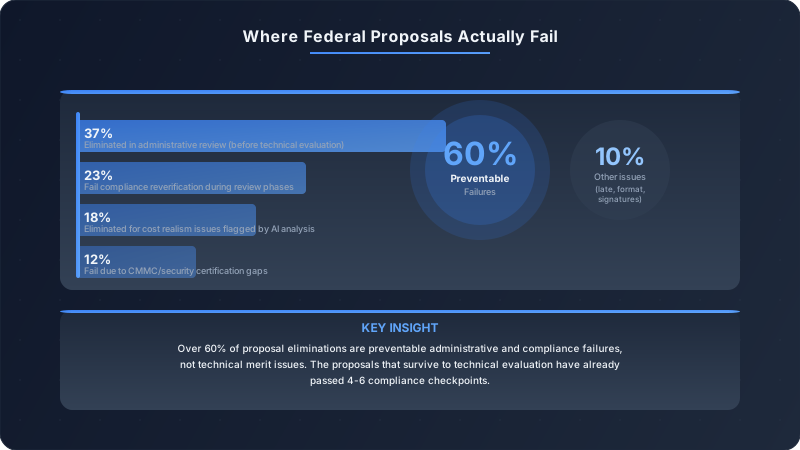
The CMMC certification timing issue eliminates contractors before they realize they're competing on uneven ground. By October 31, 2026, CMMC compliance will be required for all new DoD contract awards. But primes are demanding Level 2 certification from subs today because the October deadline creates supply chain risk they can't absorb. If you're a sub waiting for Phase 2 mandates to start your certification journey, primes have already selected competitors who finished certification in Q1 2026. You're not losing on technical merit. You're losing on timeline.
What to do when you discover a fatal compliance gap at Day 32: You have three options, none good. Option one: Submit as-is and accept administrative elimination risk. Option two: Request deadline extension based on solicitation ambiguity (only works if you can prove the gap stems from contradictory requirements, not your misreading). Option three: No-bid the solicitation and preserve your relationship for the next opportunity rather than submit a non-compliant proposal that damages your reputation.
The recovery checklist for Day 32 compliance gaps: Identify which Section L requirement you're missing. Determine if you can address it in existing sections without exceeding page limits. If not, identify which current content is filler that can be cut. Verify that adding the missing content doesn't create new gaps elsewhere. Update compliance matrix to show requirement is now addressed. Brief executive leadership on the gap, the fix, and the risk level. Document why the gap occurred so you prevent it next time.
The truth about federal RFP responses: The teams that win don't write better technical approaches. They build better compliance scaffolding. They catch administrative gaps at Day 3 instead of Day 32. They structure proposals for evaluation, not narrative. They verify FAR clauses against current databases, not template libraries. And they understand that 60% of eliminations happen before an evaluator reads your innovative solution, which means compliance isn't overhead, it's the price of entry.
Start your next proposal with the compliance matrix, not the outline. Verify every FAR clause reference on Day 1, not Day 28. Build pricing foundations during capture, not during production week. And remember that the 72-hour window after solicitation release determines whether you'll be competing on technical merit or eliminated on administrative grounds before the competition begins.